What holds
On identity
I got laid off from my first job out of college 7 months after starting.
It was a Monday, MLK day specifically, and I had the day off. I was hosting a friend from college who was visiting NYC for the first time, so I spent the entire day showing him around the city: strolling in a snow covered Central Park, admiring collections from a J.M. Basquiat art showcase at the Whitney, and even experiencing the Vision Pro for the first time at the Apple Soho store. We eventually got back to the apartment fairly late and exhausted, but the plate of Jollof rice we had made up for any tired bones.
Coming off a long weekend, I wanted to get ahead of work stuff for the next day, so I grabbed my computer and reflexively typed "g" + Enter in my browser. I now had Gmail in front of me and the first message in my inbox was from HR. It was titled "Your [Company] employment". An ominous feeling set in. I clicked on it and only needed to read the first sentence for the weight of what had just happened to fall on me: I had become the latest statistic in the now growing trend of tech companies laying off employees.
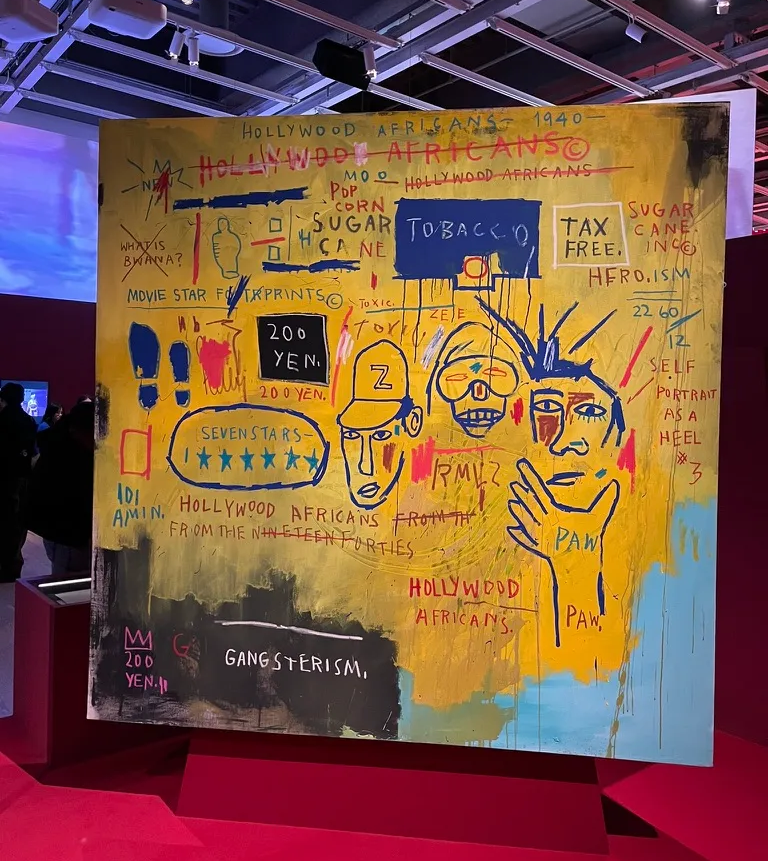
"Hollywood Africans" - Jean-Michel Basquiat
Getting laid off in any context is generally rough.
Getting laid off 7 months into your first job, as an international student whose visa status is tied to your employment status, in one of the worst job markets we've seen in decades is…let's just say I wouldn't wish that on anyone. The following days and weeks were full of uncertainty, but they also showed me how much I'd grown. Because even though it was one of the most uncertain times in my life, I had an inner peace and a countenance that a previous version of myself would have been unable to comprehend, let alone embody.
To understand why, we need to backtrack.
For much of my early adulthood, I've struggled with an identity crisis.
Growing up, I based much of my core identity and self-worth, albeit subconsciously, on external things: how smart I thought I was, the various awards I'd won, my acceptances into "highly-selective" spaces. As I grew older, I started noticing cracks in this approach to living. It was a recipe for constant mental and emotional turmoil. This became especially clear during my transition from secondary school to moving to the U.S. for college.
Some context: my financial situation while applying to these colleges meant that I needed a full-ride to be able to attend. Couple that with the fact that I'm an international student, and what's left is a limited set of hyper-competitive options.1
My first few applications ended up getting rejected and the imposter syndrome slowly crept in. I'd look at the kind of people that were getting into these places and fall into constant cycles of comparison. I had crippling fears of not feeling like I was good enough to get into these places. It challenged something in me that hadn’t been challenged to this degree before. I had never quite learnt how to fail prior to this experience, and this was the first time I'd aimed for something so high that there was a real possibility of not getting it.
I eventually received offers from some incredible institutions and ended up going to a place that was a really good fit for me. But the journey fractured something in me that arriving at the destination didn't heal. In college, surrounded by a group of highly competent peers, I experienced those same feelings of imposter syndrome that further exacerbated some of the anxiety I felt. I went from "am I good enough to make it in" to "am I good enough to even be here."2
My post-secondary-school and early college experiences viscerally highlighted just how brittle this identity was.
While I've used the "being smart" angle to illustrate the broader idea of identity fracture, I've experienced the same thing in other areas of my life: relationships, organized religion, self and public perception. These are much more personal and, in many ways, harder to articulate coherently. But the underlying thesis is the same: over time, I began to realize that much of what I had attributed to my core identity was relative in nature and built on shaky foundations. The validity of my identity was always at the mercy of external forces.
I did not want to live the rest of my life like this; something had to change.
My solution involved building my core identity on stable anchors. So, instead of adopting an identity of "being smart," it became "being curious and truth-seeking." My curiosity doesn't depend on anyone else's level of curiosity to be valid; it becomes positive-sum. Other examples include "being a reliable son/friend," "being resilient and driven," and "being kind and loving."
On the surface, this seems like it solves the issue. And I did find it to be a meaningfully better way to live, precisely because these identities are "standalone" in that they don't require anyone else's validation to hold up. But there are still cracks.
Take the "being a reliable friend" example. I've had moments where I unintentionally hurt people I cared about by saying things I wish I could retract. Experiencing something like this when your core identity is in part built on being a good friend can be jarring, to say the least. A quiet dissonance develops as you realize that even these well-meaning identity markers, with little to no room for unhealthy relative comparisons, are still not solid foundations.
I want to be clear: I wholeheartedly believe we should all strive for these virtues. Please, work on being a reliable friend, a caring partner, a loving parent. The crux of my point, however, is that even though these things are great at an individual—and societal—level, they weren't firm enough for me to anchor my entire identity on. There was this nagging feeling that there had to be more.
If these seemingly solid principles can be shaken, what then is a firm foundation?
This excerpt from this piece by Tommy Dixon captures this tension well:
Even if I found my identity in noble things, it still fails. I still will be self-centered, instead of letting my heart be drawn out toward others.
If I make being a great parent the purpose of my existence, what happens if my child is bad by nature? Or, if they're a great person, what happens when they turn 18 and leave home? If I rely on my role as a parent to be the highest calling of my life, I will be left lost and aimless and broken and bleeding when I realize that not even my child—something born of my own body—I can hold onto.
I've chased enough things in the world that I thought would give me meaning, but there was always a gap. Always an itch I could never scratch. A yearning that simply could not be satisfied. I had enough moments of feeling lost and confused after pursuing a goal that was noble and true, but still fleeting, that I decided to search for something everlasting.
In my search for that something, I ended up rekindling my relationship with God. Through my faith, I've come to understand that my core identity is not found in what others say about me, or in my job, my accomplishments, or even my "inherent virtues." It is found in Christ and what He says about me. Over time, I've grown into an identity simply rooted in being a child of God, and striving to be more like Christ, with Him as the firm foundation that I build my life on. I believe that everything I do should flow from this. And this, to me, is something absolute; it cannot be taken away by physical conditions or circumstance.3
I want to draw an important line here. When I say that my identity is rooted in my relationship with God, I do not mean institutional religion. I do not mean church attendance, denominational affiliation or even the label of "Christian." I say this as someone that is a Christian and is active in my local church community. These things are important in walking in faith and can be deeply meaningful, but they are not the foundation. They are still mediated through human systems and human interpretation. What I am describing is something more direct: a personal relationship with God that does not pass through any institution or human proxy to be real.
I think this distinction is important because the sense that earthly pursuits, even noble ones, leave something unfilled is exactly what led me here. The book of Ecclesiastes captures this with a rawness I keep coming back to, especially this verse:
Vanity of vanities, says the Preacher, vanity of vanities! All is vanity. ²
What does man gain by all the toil at which he toils under the sun? ³
- Ecclesiastes 1:2–3
That phrase, "under the sun," is what gets me. It draws a boundary around everything earthly and asks: what does any of it actually add up to? The things of this world that I strive toward, regardless of how noble or good, are ephemeral.4 They are unable to fill the deepest voids. And so they do not hold up well as a foundation for the core of who I am.
An identity founded on God and His love is the only identity that will stand the torrent of tragedy and time. In other words, only an identity founded on something outside of this world will work within this world.
Everyone builds their identity on something, whether they like it or not. Everyone has a god. It's whatever their highest thing is; whatever they honor and admire and love before all other things. Everyone worships. The only choice we get is what to worship. And the reason to choose something transcendent, as David Foster-Wallace writes about, is that anything else will eat you alive.
- Tommy Dixon
So how does this all relate to me getting laid off?
I'm not going to sit here and pretend that it was some serene, unbothered experience, because that would be a lie. I had less than 90 days to find a new job or face the possibility of having to leave the country. The implications were serious.
But in the midst of all of it, there was a peace I couldn't fully explain. Not a naive optimism or some forced positivity, but a quiet, settled resolve that things would be okay, even if "okay" looked different from what I had planned. The version of me from a few years ago would not have responded this way. That version of me had my career, my title, and the prestige of where I worked woven into the fabric of who I was. Losing that would have felt like losing myself. It would have sent me spiraling, not just because of the practical implications, but because it would have threatened something I believed was core to my identity.
But by God's grace, that was no longer where I derived my sense of self. When I got the news, I was shaken, but I wasn't shattered. There was no "who am I now?" crisis. That's because my core identity was now rooted in simply being made in the image of God. And my job status didn't change that.
Following the layoff, I stewarded the process. I applied myself, put in the work, and did everything I needed to do to find the next opportunity. But I ultimately surrendered the outcome. And that posture, the ability to hold effort and surrender in the same hand, came directly from this shift in where I rooted my sense of self. I had a peace that, frankly, surpassed my own understanding.5 Even if things hadn't worked out the way they did, even if I had to leave the country, I believe I would have been okay and found my way. Not because the situation would have been okay, but because the foundation I was standing on wasn't going anywhere.
Listen, I'm not under the illusion that my career, relationships, or ambitions won't shape how I move through the world. I know they will. I care deeply about my craft. I want to be great at what I do, and realistically, the things we pour ourselves into have a way of becoming part of how we see ourselves. I think that's fine, maybe even necessary. What I've become more intentional about is making sure those things don't seep into the deepest layer. There's a difference between something being part of my identity and something being the core of it. That core, for me, needs to be something that cannot be taken away.
Candidly, this is something I still struggle with daily. Success, validation, status... these things do feel good in the moment, and it can be very easy to let them define me. But I've started training the muscle such that anytime I feel myself anchoring my identity to something that requires the world's cosign to be valid, I course-correct by turning my sights back to something transcendent that holds regardless of circumstance.
Footnotes
-
Since the schools that offered the kind of financial aid I needed also tended to be the most selective. ↩
-
To be fair, most of what I describe here happened in my ~first year. I pedestalized the people and institutions around me, which caused me to overestimate the situation while underestimating my capabilities. Once I started seeing things more clearly and grew more accustomed to the new environment, I felt much more confident. ↩
-
In the interest of full transparency, it is worth noting that as important as my faith is to me, and as much as I strive to be more like Christ in what I do, I still wrestle with a lot. There are things that do not make complete sense to me, questions I cannot seem to find satisfying answers to, and seeming contradictions I struggle to reconcile. I wish I could give a logical, formally provable reason for why I still believe, but I cannot. A lot of it is simply a leap of faith based on personal experience. ↩
-
I truly believe we can find beauty and meaning in something, regardless of its impermanence, but I have not found that these things can serve as a good anchor. ↩
-
Philippians 4:7 ↩